



Full In-House Production Leather Bag Crafting Process
2026-04-30 20:00In leather goods manufacturing, what happens inside the factory determines what reaches your customer. HECHENG Bags Co., Ltd invites you to understand our Full In-House Production Leather Bag Crafting Process — a vertically integrated system where every stage, from hide selection to final stitching, occurs under one roof. With Vietnam's leather industry rapidly maturing and major global brands expanding their presence , our in-house approach delivers consistency, quality, and traceability that fragmented supply chains cannot match.
Why Full In-House Production Matters
When manufacturers outsource cutting, stitching, or finishing to external workshops, quality becomes unpredictable. Each subcontractor has different standards, different equipment, and different priorities. HECHENG's in-house model eliminates these variables entirely. Every leather bag follows the same process, the same quality standards, and the same inspection protocols from start to finish.
Step 1: Hide Selection and Grading
Our in-house process begins with raw material verification. Every hide arrives at our Vietnam facility with documented origin — tanneries in Italy, Brazil, and South Korea. Our specialists inspect each hide for:
Grain consistency and surface condition
Thickness uniformity (typically 1.2-1.4mm for bags)
Color matching across production batches
Natural character acceptance (scars, wrinkles acceptable for certain styles)
Only hides meeting our specifications proceed to cutting. Rejected hides return to supplier — never to your leather bag.
Step 2: Computer-Optimized Cutting
In-house cutting gives us control over material utilization. Our technicians use computer-optimized layouts to maximize yield from each hide, achieving 75-80% utilization compared to industry average of 65-70%. This efficiency reduces waste and material costs.
For your leather backpack, panels are cut with precision, grain direction matched for consistent appearance. For your leather tote bag, handle strips are cut along the spine for maximum strength. Each cut piece is tagged with its hide batch number — full traceability.
Step 3: Skiving and Edge Preparation
Thick leather requires skiving — thinning at edges and fold points. Our in-house skiving operators adjust thickness precisely for:
Leather crossbody bag strap attachment points (reducing bulk)
Leather belt bag fold lines (ensuring clean edges)
Leather backpack seam allowances (smooth interior finish)
Leather tote bag handle connections (professional appearance)
Edge finishing begins here — beveling, sanding, and preparing for painting or waxing.
Step 4: Assembly and Stitching
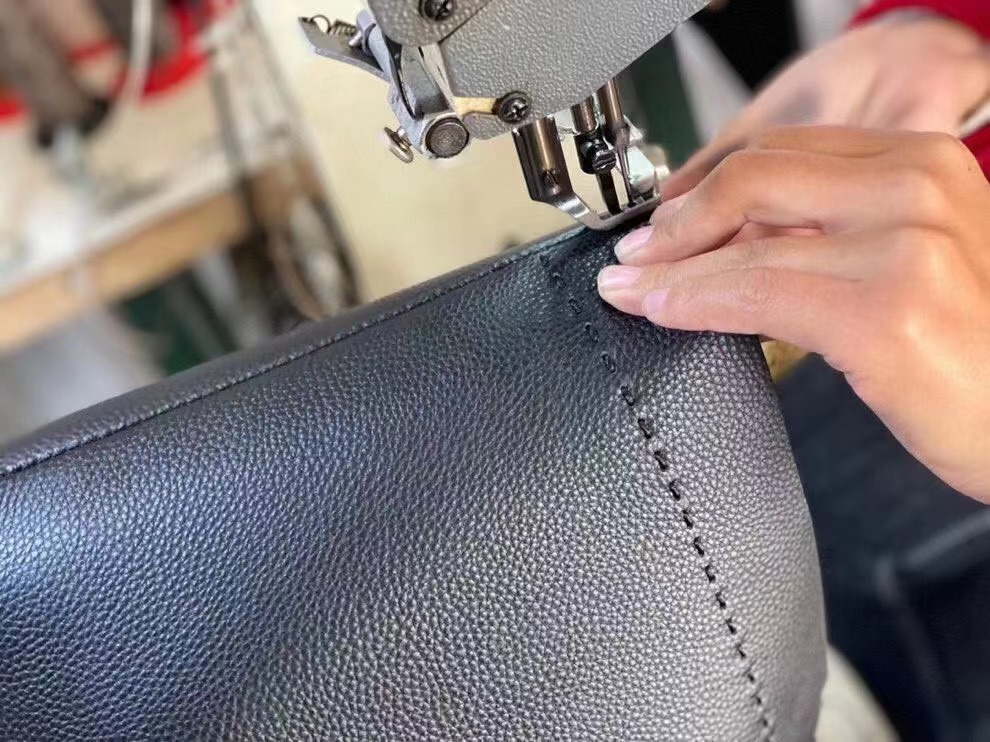
In-house stitching means consistent tension, thread quality, and seam strength. Our operators are trained on specific stitch patterns for each product category:
Leather backpack — Reinforced stress points at strap attachments
Leather tote bag — Even spacing along handle connections
Leather crossbody bag — Secure closure stitching
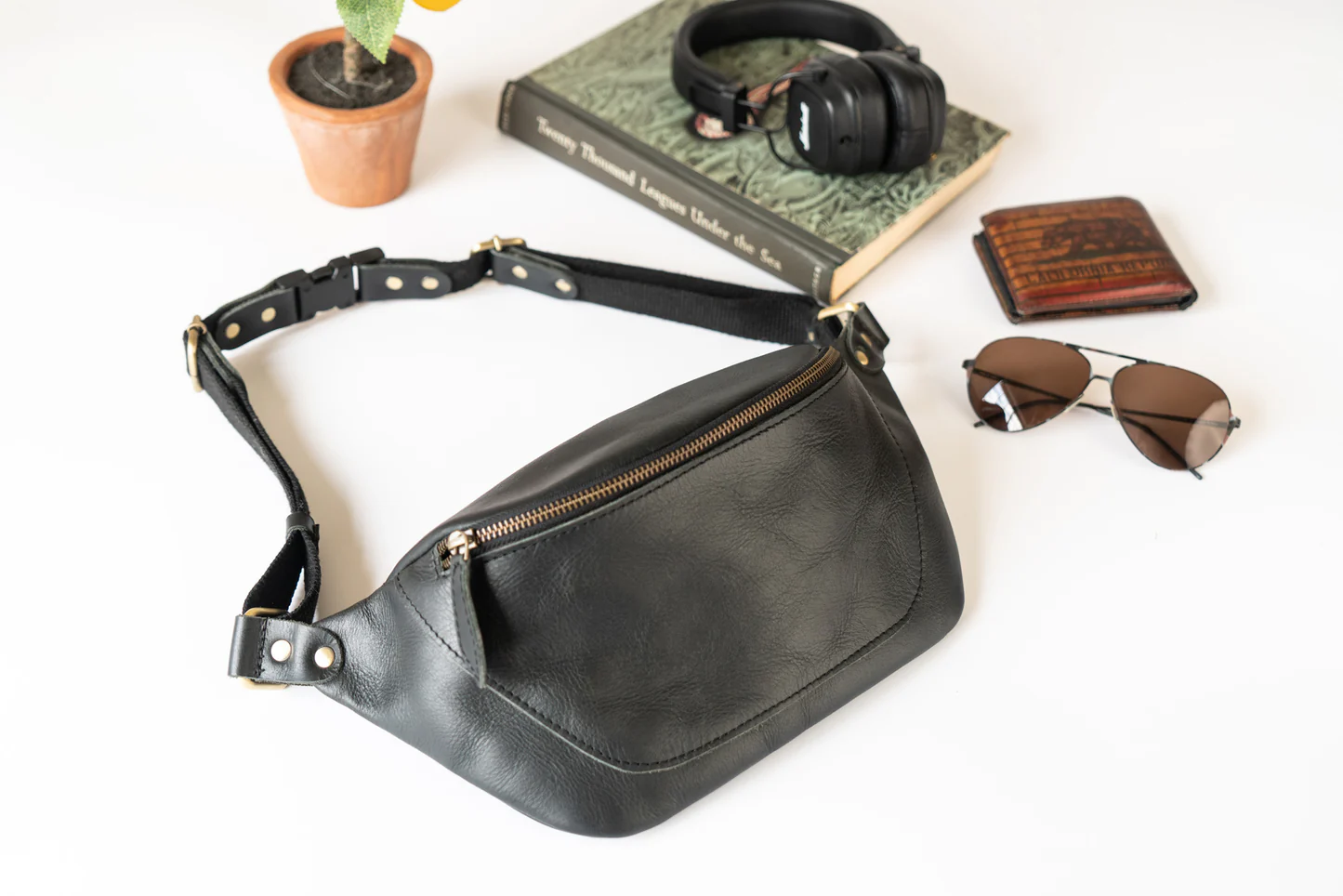
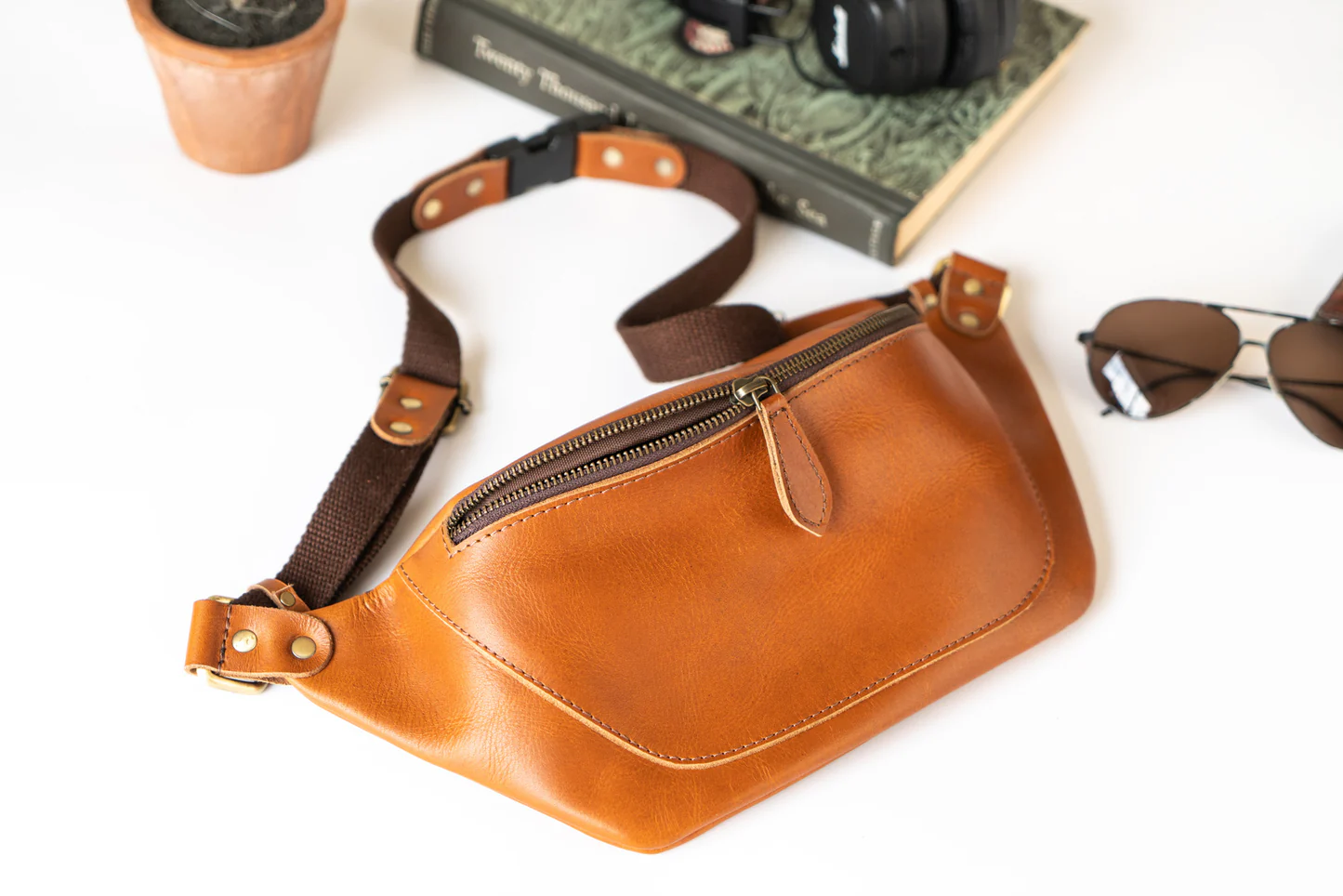
Leather belt bag — Durable webbing attachment
Each machine is calibrated daily. Stitch density is verified (minimum 8-10 stitches per inch). Thread color matched to your specifications.
Step 5: Hardware Attachment
Zippers, buckles, rivets, and snaps require precise installation. In-house hardware attachment ensures:
Rivet compression strength (no loosening over time)
Zipper alignment (smooth operation)
Magnetic snap placement (secure closure)
D-ring reinforcement (load capacity)
We test hardware function on every leather bag before proceeding to finishing.
Step 6: Edge Finishing
Visible edges define premium leather goods. Our in-house finishing team applies:
Edge paint (color-matched to leather)
Wax finishing (natural appearance)
Burnished edges (smooth, polished feel)
Each leather backpack and leather tote bag receives consistent edge treatment across all visible panels.
Step 7: Final Assembly and Closure
Components come together in final assembly. Linings are inserted (sourced from our controlled inventory). Straps are attached (length verified). Interior pockets are positioned (functionality checked). Every leather crossbody bag and leather belt bag is assembled complete.
Step 8: Quality Inspection
In-house inspection follows AQL 2.5 international standards. Our quality team examines every leather bag for:
Stitching consistency (no skipped stitches)
Hardware function (zippers, snaps, buckles)
Edge finish (no peeling or unevenness)
Lining attachment (secure and wrinkle-free)
Overall appearance (color, grain, construction)
Units failing inspection are rejected — never shipped to your customer.
In-House Advantages for Your Brand
Consistent Quality — Same operators, same equipment, same standards for every leather bag, leather backpack, leather tote bag, leather crossbody bag, and leather belt bag.
Faster Lead Times — No waiting for external workshops. Our integrated schedule means your order moves continuously through production.
Better Communication — One point of contact for your entire order. No chasing multiple subcontractors.
Full Traceability — Every component can be traced to its source — hide batch, operator, inspection date.
Cost Efficiency — No intermediary markups. No transportation between workshops. No rework from inconsistent quality.
Vietnam's Manufacturing Maturity
Vietnam has rapidly developed the infrastructure supporting in-house production. The country now hosts nearly 60 internationally accredited testing laboratories, modern industrial parks, and a skilled workforce of over 55 million . Major global brands including Nike, Adidas, Samsonite, and Tumi manufacture here, reflecting Vietnam's capability to support sophisticated production.

leather bag
leather backpack
leather tote bag
leather crossbody bag